

The 2026 Federal Budget has announced the biggest overhaul of capital gains tax in nearly 30 years. The 50% CGT discount is being replaced by a new inflation-based system with a 30% minimum tax — and the clock is already ticking.
Whether you own shares, investment property, a business, or other assets, the changes coming to capital gains tax (CGT) from 1 July 2027 will affect how much tax you pay when you sell. At The Taxation, we believe in cutting through the noise so our clients can make clear, informed decisions — so here is exactly what is happening and what it means for you.
A quick recap: how CGT works today
When you sell a CGT asset — such as an investment property, shares, or a business — for more than you paid for it, the profit (the capital gain) is added to your taxable income for that year. If you have held the asset for more than 12 months, you currently receive a 50% discount on that gain. So if you made a $100,000 gain, only $50,000 is included in your assessable income, and you pay tax on that at your marginal rate.
This 50% discount, introduced in 1999, has been one of the most powerful tax concessions in Australia’s tax system. From 1 July 2027, it is being abolished for most investors.
What’s changing from 1 July 2027?

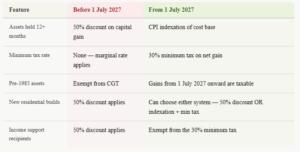
The new system replaces the flat 50% discount with cost base indexation — meaning your original purchase price is adjusted for inflation (CPI) before the gain is calculated. The idea is that you only pay tax on the real gain above inflation, rather than being taxed on inflation itself. A 30% minimum tax then applies to that net capital gain, regardless of whether your marginal tax rate would otherwise be lower.

Before vs. after: a side-by-side comparison
A real-world example
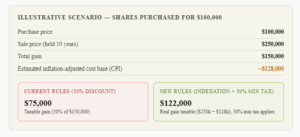
In high-inflation periods or for assets held over many years, the new system may produce a similar or lower tax outcome. But for assets with strong real gains — particularly shares or investment properties in growth markets — most investors will pay more tax under the new rules.
Transitional arrangements: protecting gains already made
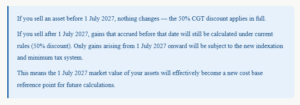
Who is exempt from the new rules?
Not everyone is swept up in the changes. The following are either exempt or have flexibility in how the rules apply to them:

What should you be thinking about right now?
The window between now and 1 July 2027 is a genuine planning opportunity. With the 50% CGT discount still available for gains realised before that date, investors should be considering whether it makes sense to act sooner rather than later — or to structure future asset decisions around the new rules.
- Review your investment portfolio and identify assets where significant capital gains have accrued — could it make sense to realise those gains before 1 July 2027?
- If you hold pre-1985 assets, understand how the transitional rules apply — gains before 1 July 2027 remain exempt, but those after are now taxable
- If you are planning to invest in residential property, factor in whether a new build — which can still access the 50% discount — is more attractive than an established property
- Revisit the role of trusts in your CGT planning — trusts are captured by the new rules, and combined with the discretionary trust minimum tax changes, your existing structure may need a rethink
- Build a long-term model for your investments that reflects your after-tax return under the new regime — the 30% minimum tax changes the maths significantly for high-income earners
It is also important to note that these changes are proposed legislation and are yet to pass Parliament. There may be amendments through negotiations with the crossbench. We will keep our clients updated as the detail becomes clearer — but the direction of travel is firmly set, and planning should begin now.
Want to understand your CGT position before the rules change?
The team at The Taxation can help you model your options, review your portfolio, and make the most of the transition window. Let’s talk before 2027.