

The Federal Budget has announced the abolition of negative gearing for established residential properties purchased after 12 May 2026. Here’s what it means for you, and what you should be doing right now.
If you own an investment property, or have been thinking about buying one, the 2026 Federal Budget has delivered a major change that will reshape the residential property investment landscape. At The Taxation, we want to make sure our clients across Melbourne understand exactly what is happening, who is affected, and how to make the most informed decisions possible going forward.
What is negative gearing, and why does it matter?
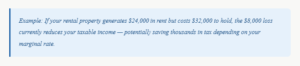
Negative gearing occurs when the costs of owning an investment property — loan interest, maintenance, council rates, and other expenses — exceed the rental income it generates. Under the current rules, that net loss can be offset against your salary or other income, reducing your overall tax bill. Combined with the 50% capital gains tax (CGT) discount on eventual sale, negative gearing has long been a key reason Australians invest in residential property.
What’s changing from 1 July 2027?
For established residential properties purchased after 7:30pm on 12 May 2026, negative gearing will be abolished from 1 July 2027. Rental losses from these properties can no longer be offset against your salary or other personal income.
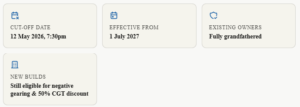
Instead of offsetting losses against general income, affected investors can only deduct rental losses against residential rental income from other properties, or capital gains when a rental property is sold. Any excess losses can be carried forward to future years — they’re not lost, but their value is deferred and limited.
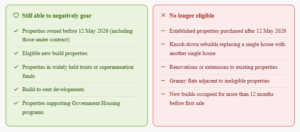
Who is protected, and who is affected?
What counts as a “new build”?
This distinction is critical, because new builds remain fully exempt and keep both negative gearing and the 50% CGT discount. Based on current guidance, eligible new builds include:
- A newly constructed apartment purchased off-the-plan
- A duplex built through a knock-down rebuild that replaces one dwelling with two (a net increase in housing supply)
- Any residential construction on previously vacant land
- A newly built property that has been occupied for less than 12 months before being sold for the first time
The key principle is whether the development genuinely adds to the housing supply. This definition may also incentivise investors to consider subdividing larger lots into multiple dwellings — something worth exploring with a qualified adviser.
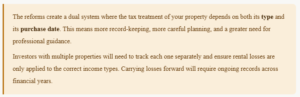
Greater complexity ahead for investors
Our take: what should investors be thinking about?
If you already own negatively geared investment properties, your position is protected — there is no reason to panic, and no need to sell. In fact, existing investors may choose to hold their properties longer, knowing the grandfathered status is tied to ownership.
For those looking to enter the property market as investors, the picture has shifted. Established residential property is now less tax-effective for new purchases, while new builds have become comparatively more attractive. Commercial property also appears unaffected by these changes and may emerge as an alternative for some investors.
Interest-only loans, historically popular for maximising deductions, may be less useful for new purchases of existing properties where negative gearing no longer applies against general income.
- Review your existing portfolio — understand which properties are grandfathered and which are not
- Reconsider your loan structure if you hold or are purchasing established property after the cut-off date
- Explore whether a new build meets your investment goals — these still attract full tax benefits
- Consider whether commercial property deserves a place in your investment mix
- Build a long-term model that accounts for your after-tax returns under the new rules
Unsure how the changes affect your property investments?
Our team at The Taxation specialises in helping investors understand exactly where they stand and plan strategically for what comes next. Let’s talk through your situation.