

The Federal Government has announced a minimum 30% tax on discretionary trust distributions, effective 1 July 2028. If your business or family wealth is held in a trust, now is the time to act.
At The Taxation, we work closely with business owners, investors, and family groups across Melbourne who rely on discretionary trusts as a core part of their financial structures. The recent Federal Budget announcement represents one of the most significant changes to trust taxation in a generation — and with no grandfathering, it will affect everyone, including existing trusts.
Here’s what you need to know, explained in plain language.
How trusts have worked until now
Discretionary trusts have long been a popular vehicle for small business and investment because of the flexibility they offer. Under the current rules, trusts are “flow-through” entities — they don’t pay tax themselves. Instead, the trustee distributes income to beneficiaries, who each pay tax at their own marginal rate. This flexibility allows families and businesses to direct income to lower-taxed beneficiaries, which is entirely legal and widely used.
If income is retained rather than distributed, the trustee pays tax at the top marginal rate of 47% (including Medicare levy).
What’s changing from 1 July 2028
From this date, trustees of discretionary trusts will be required to pay a minimum tax of 30% on the trust’s taxable income — before distributions are made.
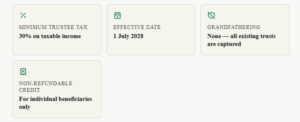
Individual beneficiaries will receive a non-refundable credit for the tax already paid by the trustee. If their marginal rate is above 30%, they’ll pay top-up tax. If it’s below 30% — such as a non-working spouse or a lower-income family member — the excess credit is simply lost.

Who will be most affected?
All discretionary trust users will be impacted, but some more than others. Those most at risk of a significant increase in their tax burden include:
- Families distributing to low-income beneficiaries (e.g. non-working spouses or adult children earning below the 30% threshold)
- Businesses using corporate beneficiaries or bucket companies to retain profits
- Groups with layered or complex trust structures
- Anyone who established a discretionary testamentary trust after Budget night
Certain trusts are excluded from the new rules, including primary production trusts (for farming income), fixed trusts, widely held trusts, superannuation funds, special disability trusts, and charitable trusts. However, even excluded groups should review their broader structures if they are beneficiaries of a discretionary trust.
What does this mean for your structure?
The short answer: everything is worth reviewing. Discretionary trusts may still offer significant asset protection benefits, so they won’t disappear entirely. But for many businesses and families, the tax calculus is shifting.
Corporate structures are likely to become more attractive for operating entities, though risks like Division 7A will need careful management. Simpler structures may also look more appealing compared to layered arrangements that become unwieldy under the new rules.
Rollover relief is expected to be made available for eligible taxpayers who wish to restructure out of a discretionary trust, but the specific details — including timing and scope — are still being worked through by the Government.
Our advice: don’t wait
The transition window to 1 July 2028 may sound generous, but legislation and guidance on the rollover relief are still forthcoming, and the planning process takes time. We strongly encourage anyone with a discretionary trust to begin reviewing their structure now — before the options narrow.
- Review whether your current trust structure remains tax-effective under the new rules
- Assess whether restructuring into a company or individual names makes sense for your situation
- Consider the future role of any corporate beneficiaries in your group
- Review your will if you intended to establish a discretionary testamentary trust
- Position yourself to take advantage of rollover relief once the legislation is finalised
Not sure how this affects you?
Our team of qualified chartered and tax accountants is here to help you navigate these changes with confidence. Book a consultation with The Taxation today.